[Warning: This post contains an image of the deceased]
–
It would be impossible, not to mention irresponsible, not to mention Damien Hirst’s reputation before mentioning any one particular piece of work his name is attached to.
‘With Dead Head’ is one of the first controversies he found himself creating, but almost his entire portfolio is like an artist statement of controversial topics and taboos.

His constant fixation and obsession with death is cause for most of these controversies, leading to backlash at his crucified skeletons, decaying cow heads in boxes of flies and severed pigs on moving machinery. His work has been criticised on one hand for being boringly effortless (“One might as well get excited about seeing a dead halibut on a slab” said art critic Robert Hughes of Hirst’s shark preserved in formaldehyde) yet on the other hand criticised for being shocking for shocks sake, attention-grabbing and disgusting with no real point. Another growing criticism of Hirst comes after the recent revelation that he outsources the actual artistic aspects of his work; he rarely does his own paintings, for example. He was quoted by the Guardian as saying, “I couldn’t be fucking arsed doing it”.

So it’s safe to say, when viewing a Hirst exhibition, viewers may think they are going to be faced with some kind of graphic photographic presentation, perhaps some art pieces he had really no involvement in, and an underlying theme of death, consumerism and the ever-constant question of “well what even is art, anyway?”
It may have come to a shock then to those who visited In And Out Of Love back in 1991 before Hirst’s notoriety became what it is now.
In And Out Of Love was an exhibition comprised of two parts; upstairs was a humid room in which pupae were attached to white canvases. The butterflies emerged from their pupae and lived their entire lives in the warm, white room, feeding on boxes of flowers and tables of fruit before dying. The downstairs part of the exhibition displayed the dead bodies of the butterflies, attached to monochromatic canvases, with tables in the middle holding ashtrays and cigarettes. The exhibition was recreated for the Tate in 2012, which drew a larger crowd given Hirst’s notoriety as it stood at the time.

In And Out Of Love remains controversial for a surprising number of reasons. The questions it engaged visitors in went far beyond Hirst’s normal questions about life and death, and called to light issues surrounding ethics in art and hypocrisy of modern life.
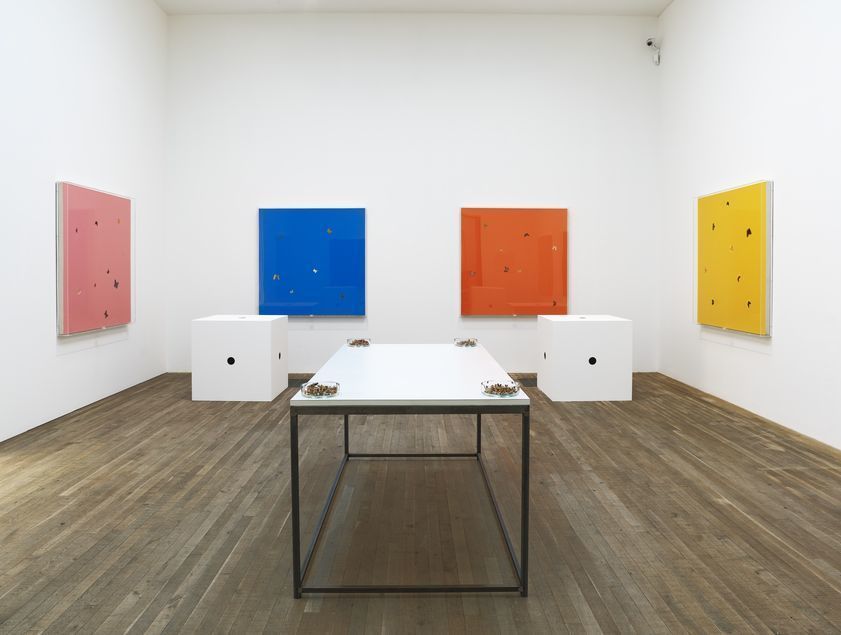
To begin with, 400 butterflies died each week of the exhibition, overall around 9,000 in total. The environment was set up in a way that was meant to be ideal for the butterflies to survive, but of course unnatural deaths occurred. Some butterflies landed on the ground in doorways, immediately stepped on by viewers as they entered the upstairs room. Some hatched malformed and were unable to fly far enough to reach their food sources. Many ate, rested, mated, lived their lifespan and then simply died. But there has always been question as to how many died because of the conditions and the traffic, and how many died naturally.

The debate surrounding the death of the butterflies then brought about discourse surrounding the precise conditions they were living in; Hirst had consulted entomologists on how the butterflies could survive, but not how they could thrive. Was living in a warm white room with limited vegetation and food really the best life the butterflies could have? Not knowing the feeling of sun, feeling no breezes that could help them to fly farther, having no knowledge of the plant life they would experience in nature? Was this fair to a butterfly? What could really be fair to a butterfly, anyway? Is an insect’s life worth as much as say, an animal? If an animal is worth the same or more than a butterfly, surely we’d all be very against the concept of a zoo. This is almost literally the equivalent of Hirst’s exhibition- animals are kept contained, provided what they need, and when they die their bodies are often displayed. Some of these animals die due to the conditions of the zoo, despite consultation from various experts on how best to care for them. Zoos, of course, aren’t immune to controversy- whether it be the lack of concern for their natural habitat or the choice of the zoo to slaughter particular animals. Does the study undertaken by zoos and the money raised by them for causes such as endangered animal care, negate the negative reactions we may feel surrounding the animals they trap?
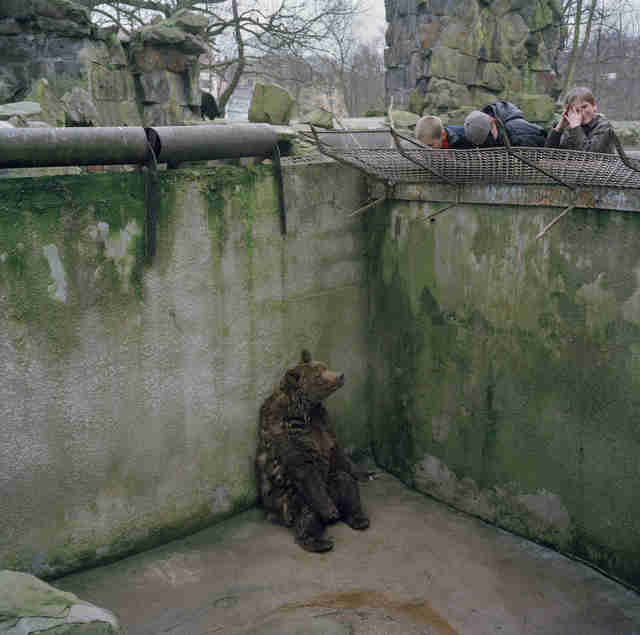
If we can agree that Hirst’s exhibition is uncomfortable but familiar, we at some point end up facing the question: why isn’t there greater backlash over our choice to keep animals as pets? Isn’t this what Hirst was essentially doing, after all- providing the butterflies what they needed to live, but keeping them in an unnatural environment to be able to contain them? We might argue that we are able to pat, play with and love our cats and dogs, but that’s only because these are beings that can appreciate such interactions. We don’t pat our goldfish, because they wouldn’t understand or like such an activity. So what do we really do for our pets, besides simply taking care of them in exchange for a sort of ownership over them? We receive health, social and mental benefits from owning a pet, and Hirst received benefits from containing his butterflies for others to view.

Art like In And Out Of Love is one of those that provides chance for dialogue about activities, morals and norms within our society. By simply displaying an insect’s life cycle in a room, so many questions are raised, and the more the viewer thinks about it, the more questions they will have.
 Death Imitates Art
Leave a comment